

Workshop

Surprised? Be part of the solution!
Imagine your coding skills could save lives. In the mobile4D project, you will use innovative software to combat dengue fever, a threat classified as critical by the WHO, especially in Southeast Asia. You will not only demonstrate your technical skills, but also make a real contribution to global health. Are you ready to use a superpower for a good cause?
The project is carried out alternately as a Bachelor’s or Master’s project under
under the supervision of Dr. Thomas Barkowsky.


Where is your talent?
A wide range of skills are used in our extensive projects. No matter where you are or what you do best, there’s a place for you here. Whether you’re already an expert in your field or just starting to discover your skills, you’ll find a space to grow, learn and contribute in our projects. Everyone brings something valuable to the table. What will you contribute?
Whether you’re an ace at Python, a virtuoso at JavaScript or a beginner at Dart, your lines of code make a difference.
From intuitive UIs to appealing graphics, your creativity makes technology accessible and engaging.
Number crunchers and algorithm acrobats, your skills turn data into decisions.
Do you have a knack for organizing things and leading teams? Here you can show what efficient planning can achieve.
Whether you create content that inspires or build bridges between cultures, your words carry weight.
Curious minds that ask questions and seek answers drive innovation.


As diverse as the demands of global health
In the world of global health, no two problems are the same – and this is reflected in our projects. At mobile4D, every code, every app and every feature is a direct response to the diverse requirements.
Django
Vue
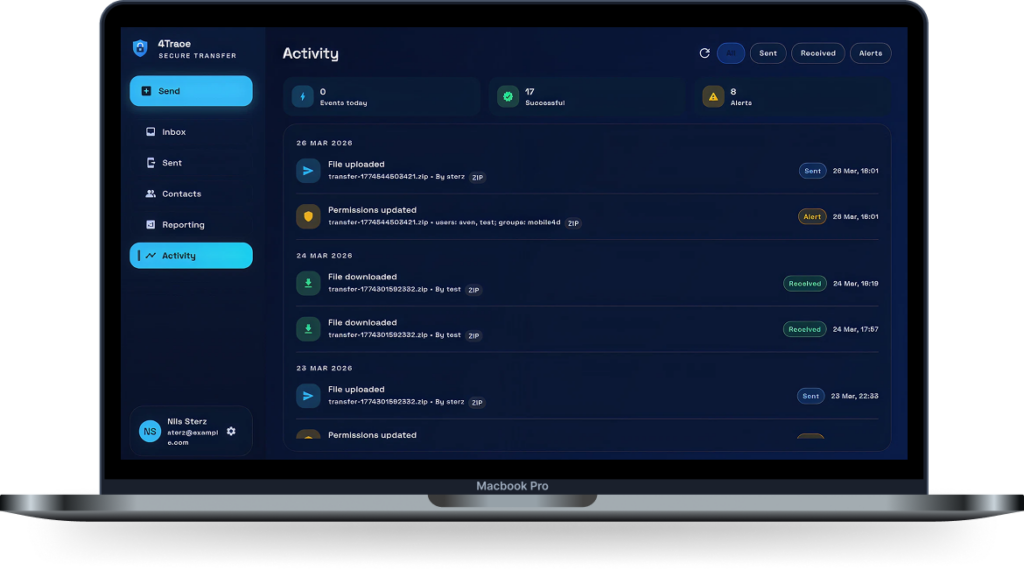
4Trace supports research teams in safely sharing their data across multiple teams, while making sure the integrity of the data is maintained.
We strive to make our system easy to use while also ensuring that non-technical users can navigate it without problems.
Our platform will also provides robust tracking and audit capabilities, giving teams full visibility into who accesses or modifies data, so research remains transparent and accountable in the near future.
Flutter
Django
Vue
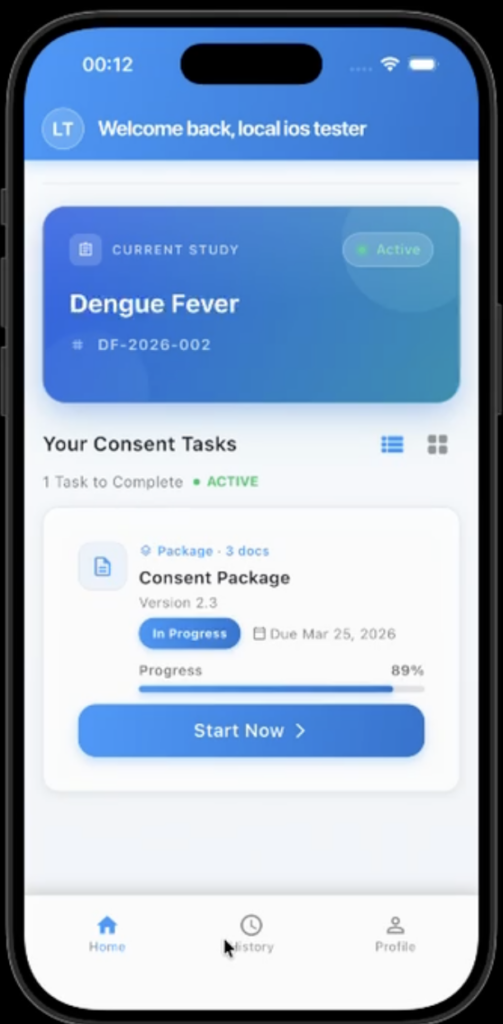
eConsent is a modern web application designed to manage informed consent processes in clinical studies digitally. The goal of the project is to replace traditional paper-based workflows with a secure, efficient, and user-friendly digital solution for both study staff and participants.
The platform enables centralized study management, participant tracking, and fully digital consent handling. It supports multiple user roles such as Study Coordinators, Investigators, and Monitors, ensuring that each user has access only to the features relevant to their responsibilities.
Features

Flutter
Django
Vue
ePRO is a system for collecting clinical trial data via surveys. It is currently being tested by our partners in Thailand in several clinical trials.
The web dashboard, which can be accessed via any web browser, is used by medical staff to create and monitor the studies and their surveys. It also provides the user with a survey builder that allows the questions of each survey to be set up and modified.
In addition, study participants can be registered individually or via a csv import. Once a survey has been started for a study participant, the collected survey data can be viewed at any time and exported to a csv file for analysis.
The mobile app is installed on study participants’ smartphones, where they can view all current and upcoming surveys. When a new survey is activated, the participant receives a push notification. The participants’ entries undergo a rule-based validation process in order to capture meaningful and consistent study data.
Features


Flutter
Django
Vue
Microclimate Monitoring is a system consisting of a mobile application and a web dashboard designed to collect, manage, and analyze environmental data from IoT weather stations. The project focuses on understanding local microclimate conditions and their impact on factors such as mosquito activity and malaria risk.
Features

FastAPI
Temporal.io
PyTorch
YOLOv5
Google Street View
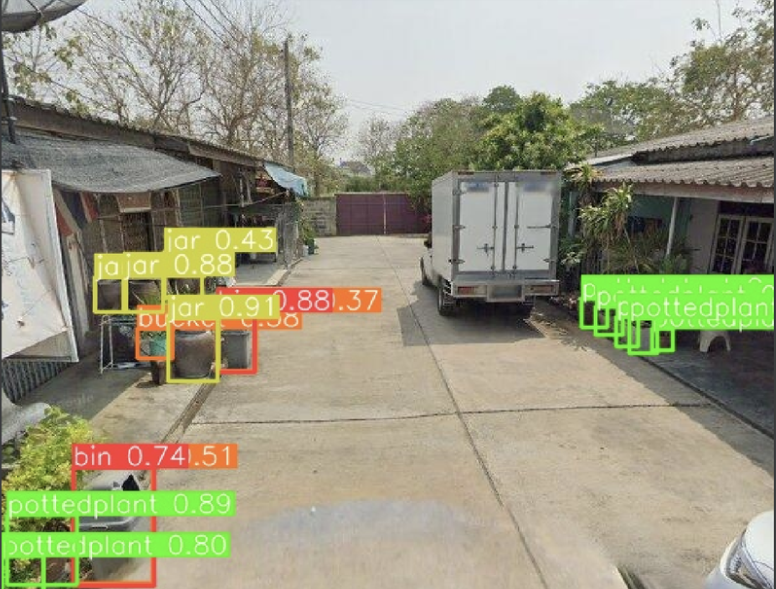
The GSV Container Count project identifies potential mosquito breeding sites in Thai street images using computer vision and machine learning. The system processes Google Street View images at various administrative levels (province, district, subdistrict) and uses a specially trained YOLOv5 model to detect containers that could serve as breeding grounds. Image processing and analysis are carried out automatically and in a scalable manner via a microservice architecture, using Temporal.io for workflow orchestration.
The results are stored in a database and can be accessed and analyzed via a REST API. Temporal dynamics play a role in tracking the development of breeding sites over time. In this way, the system supports targeted vector control measures and contributes to the prevention of dengue fever.
Features
Flutter
PyTorch
MLflow
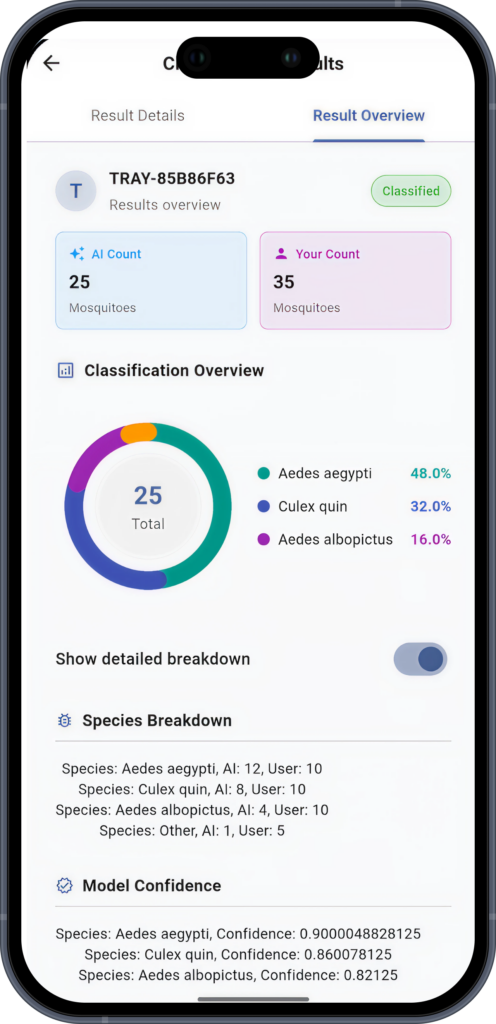
Accurately distinguishing mosquito species and sexes is crucial for research and public health protection. Only with precise identification of species and sex can the spread and threat potential of mosquito populations be effectively monitored and targeted control measures implemented efficiently. Mosquitofi supports researchers and health authorities by enabling automated identification of mosquito species and sexes based on smartphone photos. The app guides users through a clearly structured workflow: from creating new studies, to assigning traps and trays, all the way to uploading and analyzing mosquito images.
The results are stored in a database and can be accessed and analyzed via a REST API. Temporal dynamics play a role in tracking the development of breeding sites over time. In this way, the system supports targeted vector control measures and contributes to the prevention of dengue fever.
The underlying machine learning pipeline is based on state-of-the-art deep learning models in PyTorch, specifically trained to recognize different mosquito species and their sexes. MLflow ensures efficient and transparent documentation of development, training, and experiment tracking.
Features
Django
Vue
SIRcraft is an interactive web application for modeling and visualizing the spread of infectious diseases using compartmental models. It is designed to simplify complex epidemiological concepts and make them accessible even to users without prior knowledge.

Flutter
Django
Tuberculosis (TB) remains a global health threat. Sudan is among the high TB-burden countries, with over 14,000 new cases in 2024. The TB Sudan app provides structured logging of the diagnostic process for suspected TB patients. Its current purpose is the prospective collection of performance data from a pre-trained AI model.
Features

Flutter
Django
Vue
TM-Vax aims to digitize the vaccination process in hospitals and provide a digital vaccination card for their patients. The system consists of a web dashboard for use in the hospital and an app that serves as a digital vaccination card for the patient.
For the hospital, we created a dashboard that allows medical staff to manage patients, vaccines, diseases and vaccinations.
Vaccines and diseases are fully editable and expandable to stay up to date and reflect recent changes. Vaccinations can be scheduled and administered for patients and vaccines registered in the system.
The app allows you to view and edit your personal data, health status and vaccination status. Vaccination recommendations are given based on your personal profile. Users are registered through a one-time login via a QR code provided by hospital staff. Vaccination cards for all family members can be managed in the same app.
Features


Prof. Dr. Peter Haddawy, Mahidol University
Jenny, Alumna
Dr. Thomas Barkowsky, Universität Bremen
Leo, Alumnus
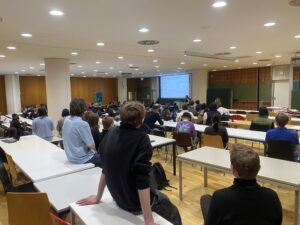
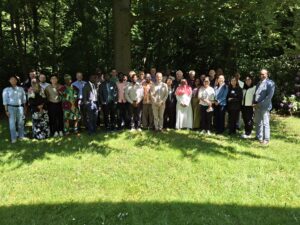
On April 17th, 2026, we reached another important milestone in our Mobile4D project: together with 15 other Bachelor’s and Master’s
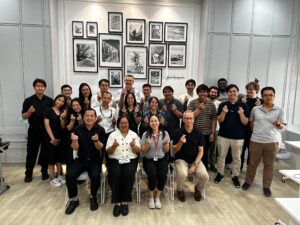
From Bremen to Thailand – Our anual Mobile4D Project Trip As part of our bachelor project Mobile4D at the University
Are you still looking for a topic for your thesis?
Are you about to complete your Bachelor’s or Master’s degree and looking for a fascinating topic for your thesis? In the project and related work, we work in exciting fields such as artificial intelligence, health informatics, web and app development and the Internet of Things (IoT). You have the freedom to choose your focus and dive deep into an area that really excites you. Below you will find examples of work that has already been created in the context of our project, showing the variety and depth of possibilities. If you have an idea or are looking for something, feel free to contact us! Below you will find a few examples of theses that have been created as part of the project.
You will win this game because you kill up to 725,000 people worldwide every year. Mosquitoes are the most dangerous animals in the world, as they transmit various diseases such as dengue fever, malaria and Zika.
You will lose this game because you only kill up to 10 people a year worldwide. Although the shark is very feared, it is rarely fatal to humans.
You’re about to become part of a groundbreaking project that will not only enhance your skills but also have a real impact. Here are the next steps to get involved:
Project introduction
Mark 21.04.2026 in your calendar! All projects will be presented here so that you can make the right choice.
Project day
On 17.04.2026 you will have the opportunity to delve deeper into the projects, talk directly to the teams and clarify your questions.
Project selection
After these events, you can decide from 21.04.2026 by 26.04.2026 which project suits you best and where you can use your skills most effectively.
If you still have questions, can’t make the dates or have something else on your mind, just send us an e-mail.